ActuVoyage

Top Game AppDevelopers

We spent four months talking to studios that build mobile games for hire, played what they shipped, then ranked the five that hold up under real production pressure.

Studios assessed 34 Shortlisted 5 Last revision July 2026

Abstract cluster of isometric cubes in the ActuVoyage palette

The ranked shortlist

Mobcoder

  • Native iOS and Android game builds in Swift and Kotlin
  • Live sessions, health coins and gamified fitness work
  • In-house QA signs off every release candidate
4.9/5
View more View more

iQlance

  • Cross-platform Unity delivery for startups and enterprises
  • AI and machine learning features built into gameplay
  • Discovery, build, deployment and long-term support in one team
4.8/5
View more View more

Light IT

  • Product discovery workshops before a line of code
  • Dedicated long-term teams for live game projects
  • Backend, matchmaking and multiplayer services
4.7/5
View more View more

Dev Technosys

  • Full-cycle 2D and 3D production under one roof
  • AR and VR game prototypes for pitch decks
  • Fixed-scope launch packages with clear milestones
4.6/5
View more View more

NMG

  • Game art, character design and animation studio
  • Monetisation, analytics and store optimisation setup
  • Post-launch content updates on a monthly cadence
4.5/5
View more View more

What is a game app?

A game app is a piece of software built for a phone or tablet whose primary job is play. It runs a loop: the player receives a goal, acts on it through touch, tilt or voice, and gets an immediate, legible response. Everything else in the product, from the store listing to the settings screen, exists to protect that loop. When people talk about a game app they usually mean a native or cross-platform build distributed through the App Store or Google Play, with progress stored on the device and synced to a server.

Technically a game app differs from a regular mobile app in three places. It renders continuously instead of waiting for input, which puts a hard budget on frame time and battery. It carries a large asset payload of sprites, models, sound and localisation, so download size and streaming strategy become product decisions. And it usually keeps a live service running behind it: leaderboards, seasonal events, remote configuration, A/B tested economies. A studio that has only shipped business apps will underestimate all three.

Commercially, a game app is a retention product. Installs are cheap to buy and easy to lose; the money sits in what happens on day two, day seven and day thirty. That is why the studios in our shortlist talk about cohort curves and session length before they talk about art style, and why we score them on what their released titles still do a year after launch rather than on how their portfolio pages look.

A useful test before you brief anyone: describe the first sixty seconds of play in plain sentences. If you cannot, the problem is the game design, not the development partner.

The best game app developers

1. Mobcoder

Mobcoder Inc is a tech company specialising in mobile app development and custom software solutions. It has delivered several gaming apps, with one notable example being Cultsport Play. The app offers users tracks ranging from 5 to 15 kilometres, letting them choose a preferred running or cycling route. It combines live sessions, a gaming layer and health coins to turn a workout into something people come back to.

Overview

Founded in 2011, the company focuses on delivering high-quality mobile and web applications, providing end-to-end development services and helping businesses reach their digital transformation goals. Clients typically span healthcare, finance and retail, which shows in how carefully the team handles data handling and release approvals.

Services

  • Native gaming apps for iPhone and iPad using Swift and Objective-C
  • Interface and experience design for mobile and web products
  • Support and update cycles that keep shipped games running efficiently
View more View more

2. iQlance

iQlance Solutions is a leading app development company in North America and a serious name in custom software across the region. The team works with startups, small businesses and enterprises to turn complicated briefs into scalable products. By combining modern technology, agile delivery and a client-focused process, iQlance ships work that carries business value as well as a good first session. Its projects cover healthcare, real estate, logistics, oil and gas, entertainment and media, restaurants, manufacturing, e-commerce, non-profits and education. From strategy and concept through development, deployment and support, the company keeps solutions technically robust and aligned with the commercial goal.

Overview

Operating out of Toronto and New York, iQlance runs cross-functional squads that pair a game designer with engineers rather than handing specifications over a wall. That structure is why its live titles tend to survive their first content update, and why enterprise clients keep it on retainer after launch.

Services

  • Interface and experience design
  • Mobile app development
  • Cross-platform app development
  • Custom software development
  • AI and machine learning development
  • Quality assurance
  • Cloud development
  • Technical support and maintenance after launch
View more View more

3. Light IT

Light IT Global is a product development company that treats a game brief as a business case first. Its best-known gaming work is a set of casual titles with social leaderboards built for European publishers, where the studio owned the backend, matchmaking and the seasonal event system rather than only the client build. Founders who arrive with a rough idea rather than a finished document tend to get the most out of this team, because discovery is where it does its strongest work.

Overview

Founded in 2007, Light IT Global runs distributed delivery teams across Europe and North America. The company focuses on long-lived digital products in healthcare, fintech, education and gaming, and staffs dedicated squads that stay with a title through several release cycles instead of rotating engineers between accounts.

Services

  • Product discovery, scoping and technical documentation
  • Unity and native game client development
  • Backend, matchmaking and multiplayer infrastructure
  • Dedicated long-term development teams
  • Analytics instrumentation and live event tooling
View more View more

4. Dev Technosys

Dev Technosys builds games end to end, from concept art to store submission, and is the practical pick when a client needs a playable build on a fixed date. Its catalogue includes puzzle and arcade titles for regional publishers plus several AR prototypes used to raise funding. The company is comfortable working from a written brief, which suits teams that already know the mechanic they want and need production muscle rather than design help.

Overview

Established in 2010, Dev Technosys operates development centres in India with client-facing offices in North America. Around 250 people cover engineering, art, animation and quality assurance, so most projects stay inside the company instead of being split across contractors, and milestone pricing is offered for well-defined scopes.

Services

  • Full-cycle 2D and 3D mobile game production
  • Unity and Unreal Engine development
  • Augmented and virtual reality prototypes
  • Game art, animation and sound integration
  • Store submission and release management
View more View more

5. NMG

NMG Technologies comes at game apps from the growth side. Alongside development it runs store optimisation, creative testing and analytics, so a launch arrives with a measurement plan attached. Its gaming portfolio leans toward casual and educational titles where art direction and steady content updates matter more than engine wizardry, and the in-house art team is the reason clients stay.

Overview

Working since 2004 from offices in India, the United States and the United Kingdom, NMG Technologies covers design, engineering and digital marketing under one contract. That combination is unusual among the studios we assessed and useful for small publishers with no marketing staff of their own, though it also means engineering capacity is smaller than at the top of this list.

Services

  • Game art, character design and animation
  • Casual and educational game development
  • Monetisation and in-app purchase setup
  • Analytics, attribution and store optimisation
  • Monthly post-launch content updates
View more View more

Types of gaming apps

Tile matching puzzle shapes on a phone screen

Casual puzzle

Short sessions, gentle difficulty and a board that resets in seconds. Cheap to produce, brutally competitive on the store, and the genre where level design quality decides everything.

Ball bouncing along ascending blocks

Hyper-casual

One mechanic, one thumb, no tutorial. Built in weeks and validated with paid creative tests before the game itself is finished. Revenue comes from rewarded video, not purchases.

Retro arcade layout with joystick and buttons

Arcade and runner

Reflex play with a rising score and an instant restart. Frame pacing matters more than content volume here, which is why this genre punishes studios that skip performance work.

Isometric hex map with a fortress tower and resource markers

Strategy and simulation

Long sessions, resource loops and an economy that has to stay balanced for years. The most expensive category to build and the one with the highest lifetime value per player.

Knight helmet with sword, shield and progress bars

Role playing

Characters, progression and story arcs. Demands real art direction, a writing budget and a content pipeline that keeps producing after launch instead of stopping at version one.

Open book turning into a tablet with learning blocks

Educational

Play in service of a curriculum, often bought by parents or schools rather than players. Accessibility, privacy compliance and measurable progress reporting are part of the specification.

Why should I develop a gaming app?

Mobile play is the widest entertainment channel there is, and it reaches people who would never install a business app. A game gives you daily contact with an audience, a mechanic for teaching something complicated without a manual, and a product that can be measured honestly: either people come back tomorrow or they do not. For brands, publishers and studios the reasoning differs, but the shape of the opportunity is the same. You are buying attention that renews itself, provided the loop is worth returning to and the studio behind it can keep shipping after launch day.

An audience already there

Phones are the default screen for casual entertainment across every age group. Distribution is solved by the stores; your job is to earn the second session.

Engagement you can measure

Retention curves, session length and completion rates tell you within a week whether the design works. Few product categories give feedback that fast.

Several ways to earn

Rewarded ads, in-app purchases, subscriptions and paid downloads can be combined. The model belongs in the design phase, not bolted on after release.

Brand memory

People remember what they played far longer than what they scrolled past. A game turns a message into an experience someone chose to spend time inside.

What is the game app development process?

Every studio names the stages differently, but the order rarely changes. Ask any shortlisted partner to map their own process onto these six steps and to tell you who owns each one. Vague answers here predict vague delivery later.

  1. Discovery and concept

    Two to four weeks. The team pins down the core loop, the target platform, the reference titles and the commercial model, then writes a scope that can actually be estimated. Prototype the mechanic here if it has never been proven.

  2. Design and art direction

    Level structure, progression curves, economy tuning and the visual language arrive together. This is the cheapest moment to change your mind, and the last one before decisions get expensive.

  3. Production

    Four to seven months for most mid-scope titles. Engineering, art and audio run in parallel sprints against a playable build that grows every two weeks. Insist on installing that build yourself.

  4. Testing and tuning

    Device coverage, frame time, crash rate, memory ceilings and a real playtest group. Balance passes happen here using data from that group rather than opinions from the meeting room.

  5. Launch

    Store assets, age ratings, privacy declarations, soft launch in one or two markets, then a staged rollout. Analytics and remote configuration must be live before the first paid install lands.

  6. Live operations

    Events, content drops, balance fixes and platform updates. Budget for this from the start; a game that stops receiving attention loses its players within a couple of months.

Game app development best practices and features

These are the items we check when scoring a studio. Each one is visible in a shipped build, so you can verify the claims yourself before signing anything.

  • Frame time budgetA locked target for the oldest device you promise to support, measured on hardware rather than in the editor.
  • Small first downloadCore loop playable within the store limit, with the rest of the assets streamed on demand.
  • Cross-platform parityOne codebase where it makes sense, native modules where performance or platform features demand it.
  • Analytics from day oneFunnel, retention and economy events instrumented before launch, not retrofitted after the numbers disappoint.
  • Remote configurationDifficulty, prices and event timing adjustable without shipping a new build through review.
  • Onboarding without walls of textThe first minute teaches by play. Tutorials that read like manuals cost you the session.
  • Live operations toolingInternal dashboards for events and rewards so content updates do not require an engineer each time.
  • Accessibility and privacyScalable text, colour-safe states, honest data declarations and compliant handling of any child audience.

How much does it cost to develop a mobile game app?

Price follows scope, not genre labels. The three bands below reflect quotes we collected while assessing studios for this ranking, expressed in Canadian dollars for a first release including art, engineering, testing and store submission. Live operations after launch typically add fifteen to twenty five per cent of the build cost per year.

Two things move a quote more than anything else. Multiplayer, because it drags in servers, matchmaking and cheat handling. And original art volume, because every extra character, environment and animation set is paid production time. If your budget is fixed, cut content breadth before you cut testing.

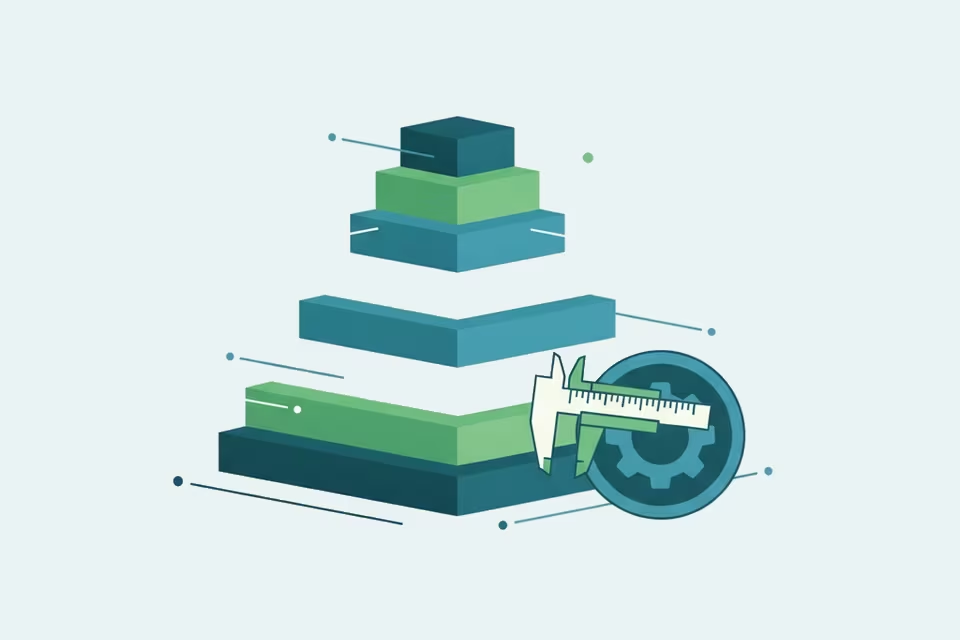
Layered plates representing project scope tiers with a caliper and gear
Indicative ranges for a first release, based on studio quotes collected in 2026.
Complexity What you get Budget Timeline
Simple One core mechanic, 2D art, offline play, rewarded ads, a handful of levels or an endless mode. CA$34,000 to 75,000 2 to 4 months
Mid-level Progression system, in-app purchases, accounts and cloud saves, seasonal events, original art set. CA$75,000 to 190,000 4 to 8 months
Complex 3D or real-time multiplayer, custom backend, live operations tooling, large content pipeline, several platforms. CA$190,000 and up 8 to 18 months

How can I benefit from game app development services?

Hiring a studio buys you more than hands. It buys a production pipeline that already exists, a QA process that has caught these bugs before, and people who know which platform rules will block a submission. For a first title that knowledge is usually worth more than the code itself, because the expensive mistakes in mobile games are structural: the wrong engine, the wrong monetisation model, an economy that cannot be rebalanced after release.

The practical benefit is speed with a floor under quality. A competent partner gets you to a testable build in weeks, tells you when the mechanic is not working, and hands over a project you can keep running whether or not you renew the contract. Ask for the repository, the documentation and the analytics access in writing at the start.

  • A team you do not have to recruit. Engineers, artists, designers and testers arrive as a working unit instead of eighteen months of hiring.
  • Fewer costly reversals. Studios that have shipped in your genre spot the economy and retention traps while changes are still cheap.
  • Faster path to a real test. A playable build in front of actual players early, which is the only reliable way to learn whether the idea holds.
  • Store and platform fluency. Ratings, privacy declarations, review rejections and staged rollouts handled by people who do it weekly.
  • Ownership you keep. Source, assets and data in your accounts, so the product survives any change of partner.